Review


monocut lambda dna molecular weight  (New England Biolabs)


Bioz Verified Symbol New England Biolabs is a verified supplier

Bioz Manufacturer Symbol New England Biolabs manufactures this product  

  • Logo
  • About
  • News
  • Press Release
  • Partners
  • Contact
  • Bioz Stars
  • Bioz vStars
  • 97

    Structured Review

    New England Biolabs monocut lambda dna molecular weight
    Monocut Lambda Dna Molecular Weight, supplied by New England Biolabs, used in various techniques. Bioz Stars score: 97/100, based on 1866 PubMed citations. ZERO BIAS - scores, article reviews, protocol conditions and more
    https://www.bioz.com/product/lambda+monocut/Lambda+DNA/pmc10790599-278-13-20
    Average 97 stars, based on 1866 article reviews
    monocut lambda dna molecular weight - by Bioz Stars, 2026-11
    97/100 stars

    Images

    Related Articles

    Construct:

    Article Title: Hidden route of protein damage through oxygen-confined photooxidation
    Article Snippet: .. The DNA constructs, modified at one end with amine group and at the other end with either azide or 2×biotin, were generated by PCR using λ DNA template (NEB, N3011S) , . .. ∼8 ml PCR product (azide-DNA:2xbiotin-DNA = 1:1) was purified using HiSpeed Plasmid Maxi kit (Qiagen) in 1 ml NaHCO 3 (pH 8.3).

    Modification:

    Article Title: Hidden route of protein damage through oxygen-confined photooxidation
    Article Snippet: .. The DNA constructs, modified at one end with amine group and at the other end with either azide or 2×biotin, were generated by PCR using λ DNA template (NEB, N3011S) , . .. ∼8 ml PCR product (azide-DNA:2xbiotin-DNA = 1:1) was purified using HiSpeed Plasmid Maxi kit (Qiagen) in 1 ml NaHCO 3 (pH 8.3).

    Article Title: Integrated multiomics signatures to optimize the accurate diagnosis of lung cancer
    Article Snippet: For cfDNA extraction, a VAHTS Serum/Plasma Circulating DNA Kit (Vazyme, Cat # N902-02) was used, and the cfDNA was quantified with a Qubit fluorometer (Life Technologies). cfDNA (10-30 ng) was applied for library construction: adapter ligation was facilitated via the VAHTS Universal DNA Library Prep Kit for Illumina (Vazyme, Cat # ND607) according to the protocol provided by the manufacturer, with spike-in controls added (0.01 pg of each amplicon per 10 ng of cfDNA). .. The spike-in control, including 3 distinct lambda DNA amplification products (~180 bp; one without modification and the other two with 5mC and 5hmC modifications), was prepared as follow : lambda DNA was PCR amplified by Taq DNA Polymerase (NEB) and purified by AMPure XP beads (Beckman Counlter) in nonoverlapping ~180 bp amplicons, with a cocktail of dATP/dGTP/dTTP and one of the following: dCTP, dmCTP or 10% dhmCTP (Zymo)/90% dCTP. ..

    Generated:

    Article Title: Hidden route of protein damage through oxygen-confined photooxidation
    Article Snippet: .. The DNA constructs, modified at one end with amine group and at the other end with either azide or 2×biotin, were generated by PCR using λ DNA template (NEB, N3011S) , . .. ∼8 ml PCR product (azide-DNA:2xbiotin-DNA = 1:1) was purified using HiSpeed Plasmid Maxi kit (Qiagen) in 1 ml NaHCO 3 (pH 8.3).

    Polymerase Chain Reaction:

    Article Title: Hidden route of protein damage through oxygen-confined photooxidation
    Article Snippet: .. The DNA constructs, modified at one end with amine group and at the other end with either azide or 2×biotin, were generated by PCR using λ DNA template (NEB, N3011S) , . .. ∼8 ml PCR product (azide-DNA:2xbiotin-DNA = 1:1) was purified using HiSpeed Plasmid Maxi kit (Qiagen) in 1 ml NaHCO 3 (pH 8.3).

    Article Title: Integrated multiomics signatures to optimize the accurate diagnosis of lung cancer
    Article Snippet: For cfDNA extraction, a VAHTS Serum/Plasma Circulating DNA Kit (Vazyme, Cat # N902-02) was used, and the cfDNA was quantified with a Qubit fluorometer (Life Technologies). cfDNA (10-30 ng) was applied for library construction: adapter ligation was facilitated via the VAHTS Universal DNA Library Prep Kit for Illumina (Vazyme, Cat # ND607) according to the protocol provided by the manufacturer, with spike-in controls added (0.01 pg of each amplicon per 10 ng of cfDNA). .. The spike-in control, including 3 distinct lambda DNA amplification products (~180 bp; one without modification and the other two with 5mC and 5hmC modifications), was prepared as follow : lambda DNA was PCR amplified by Taq DNA Polymerase (NEB) and purified by AMPure XP beads (Beckman Counlter) in nonoverlapping ~180 bp amplicons, with a cocktail of dATP/dGTP/dTTP and one of the following: dCTP, dmCTP or 10% dhmCTP (Zymo)/90% dCTP. ..

    Activity Assay:

    Article Title: Single-cell mapping of regulatory DNA:Protein interactions
    Article Snippet: After purification, the protein was denatured at 95 °C for 5 minutes, analyzed by SDS-PAGE gel (BIORAD, 4561085) and imaged by BIORAD ChemiDoc Touch Imaging System ( ). .. DNA substrates, including lambda phage DNA (NEB, N3011) or 5’ 6-FAM-labeled 30-mer dsDNA oligonucleotides (IDT, Supplementary Note ) were used for testing nb-DddA deamination activity. ..

    Methylation:

    Article Title: Distinct Control of histone H1 expression within the Histone Locus body by CRAMP1
    Article Snippet: .. The bisulfite conversion efficiency was 99.5% for all samples based on the observed methylation level of unmethylated λ-bacteriophage DNA (New England Biolabs) spiked in to each sample. .. Sequencing was performed on an Illumina NextSeq 2000 instrument with P2 kits (75-bp single-end reads).

    other:

    Article Title: Design and in vitr o anticancer assessment of a click chemistry-derived dinuclear copper artificial metallo-nuclease
    Article Snippet: The relative extension of DNA on the cover slips was estimated by stretching lambda DNA (48,502 bp, New England Biolabs) in a similar buffer to determine 1 μm stretched DNA to be ∼3000 bp.

    Article Title: The Pre-Polarization and Concentration of Cells near Micro-Electrodes Using AC Electric Fields Enhances the Electrical Cell Lysis in a Sessile Drop
    Article Snippet: First, to find the frequency needed for the cellular DNA concentration, we separately conducted a series of experiments using commercially available lambda DNA (λ-DNA; New England Biolabs, Ipswich, MA, USA) and varied the frequency of the electric field (0–20 MHz).

    Article Title: Species-specific oxygen sensing governs the initiation of vertebrate limb regeneration
    Article Snippet: At the final step, samples were eluted in 25 μl of elution buffer (Qiagen, 19086) containing 2 pg of lambda-DNA (NEB, N3011S; tagmented with Tn5 and cleaned up on columns before use) as a spike-in.

    Control:

    Article Title: Integrated multiomics signatures to optimize the accurate diagnosis of lung cancer
    Article Snippet: For cfDNA extraction, a VAHTS Serum/Plasma Circulating DNA Kit (Vazyme, Cat # N902-02) was used, and the cfDNA was quantified with a Qubit fluorometer (Life Technologies). cfDNA (10-30 ng) was applied for library construction: adapter ligation was facilitated via the VAHTS Universal DNA Library Prep Kit for Illumina (Vazyme, Cat # ND607) according to the protocol provided by the manufacturer, with spike-in controls added (0.01 pg of each amplicon per 10 ng of cfDNA). .. The spike-in control, including 3 distinct lambda DNA amplification products (~180 bp; one without modification and the other two with 5mC and 5hmC modifications), was prepared as follow : lambda DNA was PCR amplified by Taq DNA Polymerase (NEB) and purified by AMPure XP beads (Beckman Counlter) in nonoverlapping ~180 bp amplicons, with a cocktail of dATP/dGTP/dTTP and one of the following: dCTP, dmCTP or 10% dhmCTP (Zymo)/90% dCTP. ..

    Lambda DNA Preparation:

    Article Title: Integrated multiomics signatures to optimize the accurate diagnosis of lung cancer
    Article Snippet: For cfDNA extraction, a VAHTS Serum/Plasma Circulating DNA Kit (Vazyme, Cat # N902-02) was used, and the cfDNA was quantified with a Qubit fluorometer (Life Technologies). cfDNA (10-30 ng) was applied for library construction: adapter ligation was facilitated via the VAHTS Universal DNA Library Prep Kit for Illumina (Vazyme, Cat # ND607) according to the protocol provided by the manufacturer, with spike-in controls added (0.01 pg of each amplicon per 10 ng of cfDNA). .. The spike-in control, including 3 distinct lambda DNA amplification products (~180 bp; one without modification and the other two with 5mC and 5hmC modifications), was prepared as follow : lambda DNA was PCR amplified by Taq DNA Polymerase (NEB) and purified by AMPure XP beads (Beckman Counlter) in nonoverlapping ~180 bp amplicons, with a cocktail of dATP/dGTP/dTTP and one of the following: dCTP, dmCTP or 10% dhmCTP (Zymo)/90% dCTP. ..

    Article Title: Primer-independent DNA polymerases and their use for DNA synthesis
    Article Snippet: .. Lambda DNA ladder used as a size marker was labeled by filling-in with Klenow fragment (New England Biolabs) in the presence of [α-32P]dATP. .. Replication of homopolymeric single stranded template was performed in similar conditions, using the 33-mer oligonucleotides (IDT) with the indicated sequences (Table 2), containing a terminal 3′-3′ inverted 3′-3′ inverted link to prevent both primer extension and exonucleolytic degradation.

    Amplification:

    Article Title: Integrated multiomics signatures to optimize the accurate diagnosis of lung cancer
    Article Snippet: For cfDNA extraction, a VAHTS Serum/Plasma Circulating DNA Kit (Vazyme, Cat # N902-02) was used, and the cfDNA was quantified with a Qubit fluorometer (Life Technologies). cfDNA (10-30 ng) was applied for library construction: adapter ligation was facilitated via the VAHTS Universal DNA Library Prep Kit for Illumina (Vazyme, Cat # ND607) according to the protocol provided by the manufacturer, with spike-in controls added (0.01 pg of each amplicon per 10 ng of cfDNA). .. The spike-in control, including 3 distinct lambda DNA amplification products (~180 bp; one without modification and the other two with 5mC and 5hmC modifications), was prepared as follow : lambda DNA was PCR amplified by Taq DNA Polymerase (NEB) and purified by AMPure XP beads (Beckman Counlter) in nonoverlapping ~180 bp amplicons, with a cocktail of dATP/dGTP/dTTP and one of the following: dCTP, dmCTP or 10% dhmCTP (Zymo)/90% dCTP. ..

    Purification:

    Article Title: Integrated multiomics signatures to optimize the accurate diagnosis of lung cancer
    Article Snippet: For cfDNA extraction, a VAHTS Serum/Plasma Circulating DNA Kit (Vazyme, Cat # N902-02) was used, and the cfDNA was quantified with a Qubit fluorometer (Life Technologies). cfDNA (10-30 ng) was applied for library construction: adapter ligation was facilitated via the VAHTS Universal DNA Library Prep Kit for Illumina (Vazyme, Cat # ND607) according to the protocol provided by the manufacturer, with spike-in controls added (0.01 pg of each amplicon per 10 ng of cfDNA). .. The spike-in control, including 3 distinct lambda DNA amplification products (~180 bp; one without modification and the other two with 5mC and 5hmC modifications), was prepared as follow : lambda DNA was PCR amplified by Taq DNA Polymerase (NEB) and purified by AMPure XP beads (Beckman Counlter) in nonoverlapping ~180 bp amplicons, with a cocktail of dATP/dGTP/dTTP and one of the following: dCTP, dmCTP or 10% dhmCTP (Zymo)/90% dCTP. ..

    Marker:

    Article Title: Primer-independent DNA polymerases and their use for DNA synthesis
    Article Snippet: .. Lambda DNA ladder used as a size marker was labeled by filling-in with Klenow fragment (New England Biolabs) in the presence of [α-32P]dATP. .. Replication of homopolymeric single stranded template was performed in similar conditions, using the 33-mer oligonucleotides (IDT) with the indicated sequences (Table 2), containing a terminal 3′-3′ inverted 3′-3′ inverted link to prevent both primer extension and exonucleolytic degradation.

    Labeling:

    Article Title: Primer-independent DNA polymerases and their use for DNA synthesis
    Article Snippet: .. Lambda DNA ladder used as a size marker was labeled by filling-in with Klenow fragment (New England Biolabs) in the presence of [α-32P]dATP. .. Replication of homopolymeric single stranded template was performed in similar conditions, using the 33-mer oligonucleotides (IDT) with the indicated sequences (Table 2), containing a terminal 3′-3′ inverted 3′-3′ inverted link to prevent both primer extension and exonucleolytic degradation.


    Similar Products

    94
    New England Biolabs λ dna monocut mix
    λ Dna Monocut Mix, supplied by New England Biolabs, used in various techniques. Bioz Stars score: 94/100, based on 1 PubMed citations. ZERO BIAS - scores, article reviews, protocol conditions and more
    https://www.bioz.com/product/lambda+monocut/Lambda+DNA-Mono+Cut+Mix/pm40907426-94-77-102
    Average 94 stars, based on 1 article reviews
    λ dna monocut mix - by Bioz Stars, 2026-11
    94/100 stars
      Buy from Supplier

    94
    New England Biolabs monocut lambda
    Monocut Lambda, supplied by New England Biolabs, used in various techniques. Bioz Stars score: 94/100, based on 1 PubMed citations. ZERO BIAS - scores, article reviews, protocol conditions and more
    https://www.bioz.com/product/lambda+monocut/Lambda+DNA-Mono+Cut+Mix/pm32599056-319-24-28
    Average 94 stars, based on 1 article reviews
    monocut lambda - by Bioz Stars, 2026-11
    94/100 stars
      Buy from Supplier

    97
    New England Biolabs te monocut lambda dna molecular weight
    Te Monocut Lambda Dna Molecular Weight, supplied by New England Biolabs, used in various techniques. Bioz Stars score: 97/100, based on 1 PubMed citations. ZERO BIAS - scores, article reviews, protocol conditions and more
    https://www.bioz.com/product/lambda+monocut/Lambda+DNA/pm32599056-304-10-18
    Average 97 stars, based on 1 article reviews
    te monocut lambda dna molecular weight - by Bioz Stars, 2026-11
    97/100 stars
      Buy from Supplier

    94
    New England Biolabs lambda monocut ladder
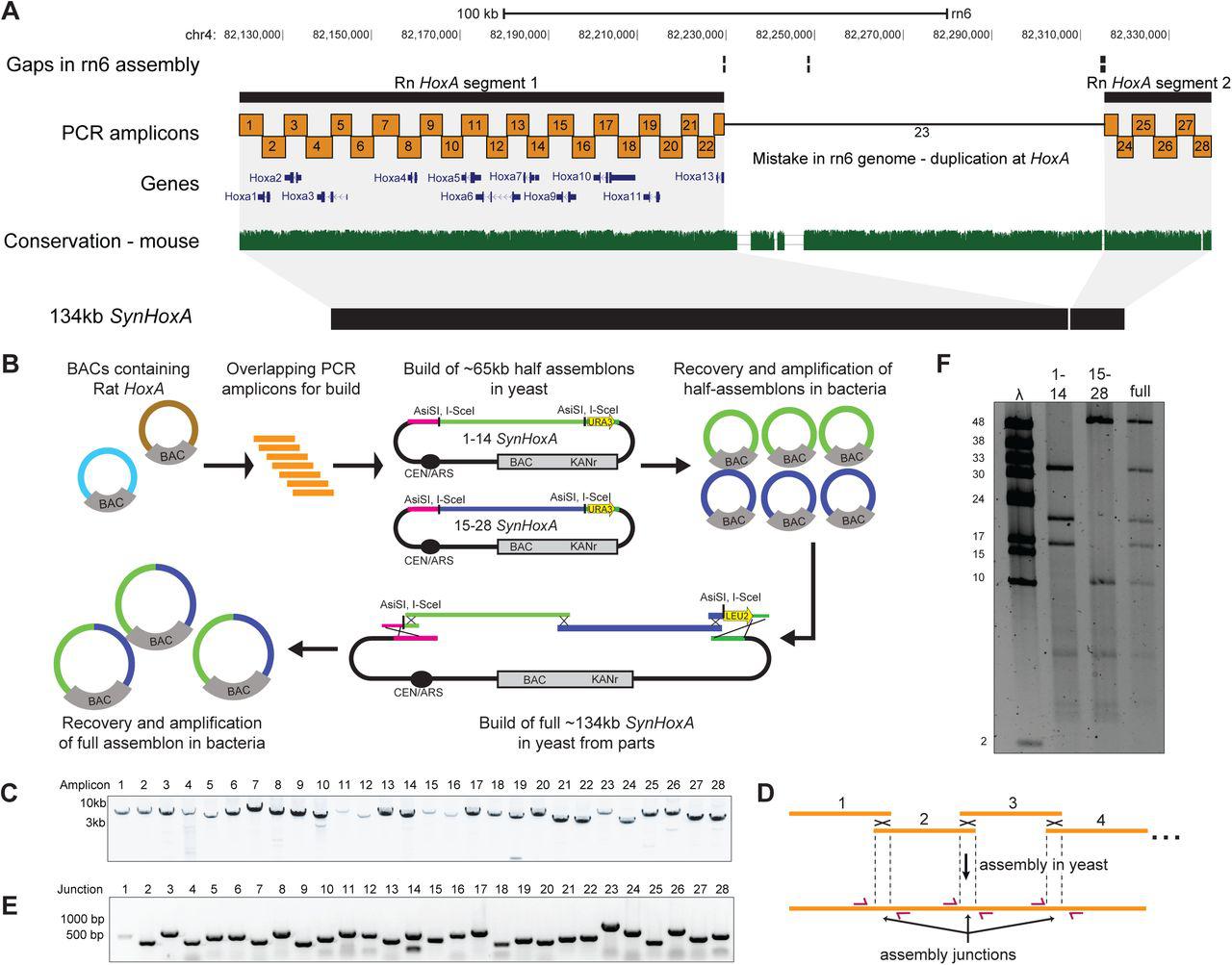
    (A) Layout of rat HoxA locus in the rn6 genome assembly. The rn6 genome includes an erroneous duplication at the HoxA locus between gaps in the assembly. The SynHoxA assemblon sequence is based on bringing together the two ‘separate’ RnHoxA segments. The sequence was segmented into 28 ∼5kb PCR amplicons with terminal homology of ∼200bp to adjacent amplicons. Conservation to the mouse genome is depicted using the multiz track from the UCSC genome browser. (B) Schematic depicting the assembly workflow for the 134kb SynHoxA assemblon. BACs containing Rat HoxA were used as PCR template to generate 28 segments tiling the entire HoxA locus. These segments were co-transformed into yeast with appropriate linkers and assembly vector to build two ∼65kb half assemblons into centromeric yeast-bacteria shuttle vectors. These half assemblons are recovered to bacteria and amplified. Full 134kb assemblon was built from half assemblons after releasing them from the vector using terminal restriction enzymes ( AsiSI ) and transforming into yeast. Full assemblon was then recovered from yeast into bacteria for amplification and verification. (C) Agarose gel of the 28 PCR amplicons that tile the 134kb SynHoxA assemblon. (D) Strategy to PCR-screen yeast colonies derived from assembly experiments. Primers (red arrows) span assembly junctions and test presence/absence of amplicons in many yeast colonies. Reproduced from ref with permission from authors. (E) Agarose gel showing one yeast colony carrying the full 134kb SynHoxA assemblon verified manually for the presence of all assembly junctions, using the strategy outlined in panel D. (F) Half and Full 134kb SynHoxA assemblon BACs purified from E.coli were digested with PvuI and separated using field inversion gel electrophoresis (FIGE). <t>Lambda</t> <t>monocut</t> ladder sizes are indicated in kb. Band sizes correspond to expected fragments.
    Lambda Monocut Ladder, supplied by New England Biolabs, used in various techniques. Bioz Stars score: 94/100, based on 1 PubMed citations. ZERO BIAS - scores, article reviews, protocol conditions and more
    https://www.bioz.com/product/lambda+monocut/Lambda+DNA-Mono+Cut+Mix/bio_rxiv__2021__07__07__451065-242-3-6
    Average 94 stars, based on 1 article reviews
    lambda monocut ladder - by Bioz Stars, 2026-11
    94/100 stars
      Buy from Supplier

    97
    New England Biolabs monocut lambda dna molecular weight
    (A) Layout of rat HoxA locus in the rn6 genome assembly. The rn6 genome includes an erroneous duplication at the HoxA locus between gaps in the assembly. The SynHoxA assemblon sequence is based on bringing together the two ‘separate’ RnHoxA segments. The sequence was segmented into 28 ∼5kb PCR amplicons with terminal homology of ∼200bp to adjacent amplicons. Conservation to the mouse genome is depicted using the multiz track from the UCSC genome browser. (B) Schematic depicting the assembly workflow for the 134kb SynHoxA assemblon. BACs containing Rat HoxA were used as PCR template to generate 28 segments tiling the entire HoxA locus. These segments were co-transformed into yeast with appropriate linkers and assembly vector to build two ∼65kb half assemblons into centromeric yeast-bacteria shuttle vectors. These half assemblons are recovered to bacteria and amplified. Full 134kb assemblon was built from half assemblons after releasing them from the vector using terminal restriction enzymes ( AsiSI ) and transforming into yeast. Full assemblon was then recovered from yeast into bacteria for amplification and verification. (C) Agarose gel of the 28 PCR amplicons that tile the 134kb SynHoxA assemblon. (D) Strategy to PCR-screen yeast colonies derived from assembly experiments. Primers (red arrows) span assembly junctions and test presence/absence of amplicons in many yeast colonies. Reproduced from ref with permission from authors. (E) Agarose gel showing one yeast colony carrying the full 134kb SynHoxA assemblon verified manually for the presence of all assembly junctions, using the strategy outlined in panel D. (F) Half and Full 134kb SynHoxA assemblon BACs purified from E.coli were digested with PvuI and separated using field inversion gel electrophoresis (FIGE). <t>Lambda</t> <t>monocut</t> ladder sizes are indicated in kb. Band sizes correspond to expected fragments.
    Monocut Lambda Dna Molecular Weight, supplied by New England Biolabs, used in various techniques. Bioz Stars score: 97/100, based on 1 PubMed citations. ZERO BIAS - scores, article reviews, protocol conditions and more
    https://www.bioz.com/product/lambda+monocut/Lambda+DNA/pmc10790599-278-13-20
    Average 97 stars, based on 1 article reviews
    monocut lambda dna molecular weight - by Bioz Stars, 2026-11
    97/100 stars
      Buy from Supplier

    94
    New England Biolabs lambda monocut
    (A) Layout of rat HoxA locus in the rn6 genome assembly. The rn6 genome includes an erroneous duplication at the HoxA locus between gaps in the assembly. The SynHoxA assemblon sequence is based on bringing together the two ‘separate’ RnHoxA segments. The sequence was segmented into 28 ∼5kb PCR amplicons with terminal homology of ∼200bp to adjacent amplicons. Conservation to the mouse genome is depicted using the multiz track from the UCSC genome browser. (B) Schematic depicting the assembly workflow for the 134kb SynHoxA assemblon. BACs containing Rat HoxA were used as PCR template to generate 28 segments tiling the entire HoxA locus. These segments were co-transformed into yeast with appropriate linkers and assembly vector to build two ∼65kb half assemblons into centromeric yeast-bacteria shuttle vectors. These half assemblons are recovered to bacteria and amplified. Full 134kb assemblon was built from half assemblons after releasing them from the vector using terminal restriction enzymes ( AsiSI ) and transforming into yeast. Full assemblon was then recovered from yeast into bacteria for amplification and verification. (C) Agarose gel of the 28 PCR amplicons that tile the 134kb SynHoxA assemblon. (D) Strategy to PCR-screen yeast colonies derived from assembly experiments. Primers (red arrows) span assembly junctions and test presence/absence of amplicons in many yeast colonies. Reproduced from ref with permission from authors. (E) Agarose gel showing one yeast colony carrying the full 134kb SynHoxA assemblon verified manually for the presence of all assembly junctions, using the strategy outlined in panel D. (F) Half and Full 134kb SynHoxA assemblon BACs purified from E.coli were digested with PvuI and separated using field inversion gel electrophoresis (FIGE). <t>Lambda</t> <t>monocut</t> ladder sizes are indicated in kb. Band sizes correspond to expected fragments.
    Lambda Monocut, supplied by New England Biolabs, used in various techniques. Bioz Stars score: 94/100, based on 1 PubMed citations. ZERO BIAS - scores, article reviews, protocol conditions and more
    https://www.bioz.com/product/lambda+monocut/Lambda+DNA-Mono+Cut+Mix/10__1128_slash_jvi__01983___18-144-44-49
    Average 94 stars, based on 1 article reviews
    lambda monocut - by Bioz Stars, 2026-11
    94/100 stars
      Buy from Supplier

    90
    Alpha Innotech lambda dna-monocut mix
    (A) Layout of rat HoxA locus in the rn6 genome assembly. The rn6 genome includes an erroneous duplication at the HoxA locus between gaps in the assembly. The SynHoxA assemblon sequence is based on bringing together the two ‘separate’ RnHoxA segments. The sequence was segmented into 28 ∼5kb PCR amplicons with terminal homology of ∼200bp to adjacent amplicons. Conservation to the mouse genome is depicted using the multiz track from the UCSC genome browser. (B) Schematic depicting the assembly workflow for the 134kb SynHoxA assemblon. BACs containing Rat HoxA were used as PCR template to generate 28 segments tiling the entire HoxA locus. These segments were co-transformed into yeast with appropriate linkers and assembly vector to build two ∼65kb half assemblons into centromeric yeast-bacteria shuttle vectors. These half assemblons are recovered to bacteria and amplified. Full 134kb assemblon was built from half assemblons after releasing them from the vector using terminal restriction enzymes ( AsiSI ) and transforming into yeast. Full assemblon was then recovered from yeast into bacteria for amplification and verification. (C) Agarose gel of the 28 PCR amplicons that tile the 134kb SynHoxA assemblon. (D) Strategy to PCR-screen yeast colonies derived from assembly experiments. Primers (red arrows) span assembly junctions and test presence/absence of amplicons in many yeast colonies. Reproduced from ref with permission from authors. (E) Agarose gel showing one yeast colony carrying the full 134kb SynHoxA assemblon verified manually for the presence of all assembly junctions, using the strategy outlined in panel D. (F) Half and Full 134kb SynHoxA assemblon BACs purified from E.coli were digested with PvuI and separated using field inversion gel electrophoresis (FIGE). <t>Lambda</t> <t>monocut</t> ladder sizes are indicated in kb. Band sizes correspond to expected fragments.
    Lambda Dna Monocut Mix, supplied by Alpha Innotech, used in various techniques. Bioz Stars score: 90/100, based on 1 PubMed citations. ZERO BIAS - scores, article reviews, protocol conditions and more
    https://www.bioz.com/product/lambda+monocut/lambda+dna+monocut+mix/pm28616744-50-21-29
    Average 90 stars, based on 1 article reviews
    lambda dna-monocut mix - by Bioz Stars, 2026-11
    90/100 stars
      Buy from Supplier

    Image Search Results


    (A) Layout of rat HoxA locus in the rn6 genome assembly. The rn6 genome includes an erroneous duplication at the HoxA locus between gaps in the assembly. The SynHoxA assemblon sequence is based on bringing together the two ‘separate’ RnHoxA segments. The sequence was segmented into 28 ∼5kb PCR amplicons with terminal homology of ∼200bp to adjacent amplicons. Conservation to the mouse genome is depicted using the multiz track from the UCSC genome browser. (B) Schematic depicting the assembly workflow for the 134kb SynHoxA assemblon. BACs containing Rat HoxA were used as PCR template to generate 28 segments tiling the entire HoxA locus. These segments were co-transformed into yeast with appropriate linkers and assembly vector to build two ∼65kb half assemblons into centromeric yeast-bacteria shuttle vectors. These half assemblons are recovered to bacteria and amplified. Full 134kb assemblon was built from half assemblons after releasing them from the vector using terminal restriction enzymes ( AsiSI ) and transforming into yeast. Full assemblon was then recovered from yeast into bacteria for amplification and verification. (C) Agarose gel of the 28 PCR amplicons that tile the 134kb SynHoxA assemblon. (D) Strategy to PCR-screen yeast colonies derived from assembly experiments. Primers (red arrows) span assembly junctions and test presence/absence of amplicons in many yeast colonies. Reproduced from ref with permission from authors. (E) Agarose gel showing one yeast colony carrying the full 134kb SynHoxA assemblon verified manually for the presence of all assembly junctions, using the strategy outlined in panel D. (F) Half and Full 134kb SynHoxA assemblon BACs purified from E.coli were digested with PvuI and separated using field inversion gel electrophoresis (FIGE). Lambda monocut ladder sizes are indicated in kb. Band sizes correspond to expected fragments.

    Journal: bioRxiv

    Article Title: Synthetic genomic reconstitution reveals principles of mammalian Hox cluster regulation

    doi: 10.1101/2021.07.07.451065

    Figure Lengend Snippet: (A) Layout of rat HoxA locus in the rn6 genome assembly. The rn6 genome includes an erroneous duplication at the HoxA locus between gaps in the assembly. The SynHoxA assemblon sequence is based on bringing together the two ‘separate’ RnHoxA segments. The sequence was segmented into 28 ∼5kb PCR amplicons with terminal homology of ∼200bp to adjacent amplicons. Conservation to the mouse genome is depicted using the multiz track from the UCSC genome browser. (B) Schematic depicting the assembly workflow for the 134kb SynHoxA assemblon. BACs containing Rat HoxA were used as PCR template to generate 28 segments tiling the entire HoxA locus. These segments were co-transformed into yeast with appropriate linkers and assembly vector to build two ∼65kb half assemblons into centromeric yeast-bacteria shuttle vectors. These half assemblons are recovered to bacteria and amplified. Full 134kb assemblon was built from half assemblons after releasing them from the vector using terminal restriction enzymes ( AsiSI ) and transforming into yeast. Full assemblon was then recovered from yeast into bacteria for amplification and verification. (C) Agarose gel of the 28 PCR amplicons that tile the 134kb SynHoxA assemblon. (D) Strategy to PCR-screen yeast colonies derived from assembly experiments. Primers (red arrows) span assembly junctions and test presence/absence of amplicons in many yeast colonies. Reproduced from ref with permission from authors. (E) Agarose gel showing one yeast colony carrying the full 134kb SynHoxA assemblon verified manually for the presence of all assembly junctions, using the strategy outlined in panel D. (F) Half and Full 134kb SynHoxA assemblon BACs purified from E.coli were digested with PvuI and separated using field inversion gel electrophoresis (FIGE). Lambda monocut ladder sizes are indicated in kb. Band sizes correspond to expected fragments.

    Article Snippet: 500 ng of lambda monocut ladder (New England Biolabs N3019S) were used as a molecular weight standard.

    Techniques: Sequencing, Transformation Assay, Plasmid Preparation, Amplification, Agarose Gel Electrophoresis, Derivative Assay, Purification, Nucleic Acid Electrophoresis

    (A) Layout of rat HoxA locus from the rn6 genome assembly depicting genes, Rn HoxA cluster segments in black and previously identified distal enhancers in purple. The Enhancers+SynHoxA assemblon sequence is made by stringing all the enhancers directly upstream of the SynHoxA assemblon sequence. Conservation to mouse genome is depicted using multiz track from the UCSC genome browser. (B) PCR amplicons tiling enhancer sequences were generated from Rat HoxA BACs and co-transformed into a yeast strain containing the 134kb SynHoxA assemblon with a gRNA vector targeting the left terminus of the 134kb assemblon. The enhancer PCR amplicons were used to repair this break, resulting in the construction of the 170kb Enhancers+SynHoxA assemblon. Assemblon was recovered into bacteria for amplification and verification. (C) Agarose gel of the 8 PCR amplicons containing enhancer sequences. (D) Agarose gel showing one yeast colony tested for the presence of novel enhancer assembly junctions and with primers spanning 134kb SynHoxA . (E) 134kb and 170kb assemblon BACs purified from E.coli were digested with PvuI and separated using FIGE. Lambda monocut ladder sizes are indicated in kb. Band sizes correspond to expected fragments.

    Journal: bioRxiv

    Article Title: Synthetic genomic reconstitution reveals principles of mammalian Hox cluster regulation

    doi: 10.1101/2021.07.07.451065

    Figure Lengend Snippet: (A) Layout of rat HoxA locus from the rn6 genome assembly depicting genes, Rn HoxA cluster segments in black and previously identified distal enhancers in purple. The Enhancers+SynHoxA assemblon sequence is made by stringing all the enhancers directly upstream of the SynHoxA assemblon sequence. Conservation to mouse genome is depicted using multiz track from the UCSC genome browser. (B) PCR amplicons tiling enhancer sequences were generated from Rat HoxA BACs and co-transformed into a yeast strain containing the 134kb SynHoxA assemblon with a gRNA vector targeting the left terminus of the 134kb assemblon. The enhancer PCR amplicons were used to repair this break, resulting in the construction of the 170kb Enhancers+SynHoxA assemblon. Assemblon was recovered into bacteria for amplification and verification. (C) Agarose gel of the 8 PCR amplicons containing enhancer sequences. (D) Agarose gel showing one yeast colony tested for the presence of novel enhancer assembly junctions and with primers spanning 134kb SynHoxA . (E) 134kb and 170kb assemblon BACs purified from E.coli were digested with PvuI and separated using FIGE. Lambda monocut ladder sizes are indicated in kb. Band sizes correspond to expected fragments.

    Article Snippet: 500 ng of lambda monocut ladder (New England Biolabs N3019S) were used as a molecular weight standard.

    Techniques: Sequencing, Generated, Transformation Assay, Plasmid Preparation, Amplification, Agarose Gel Electrophoresis, Purification

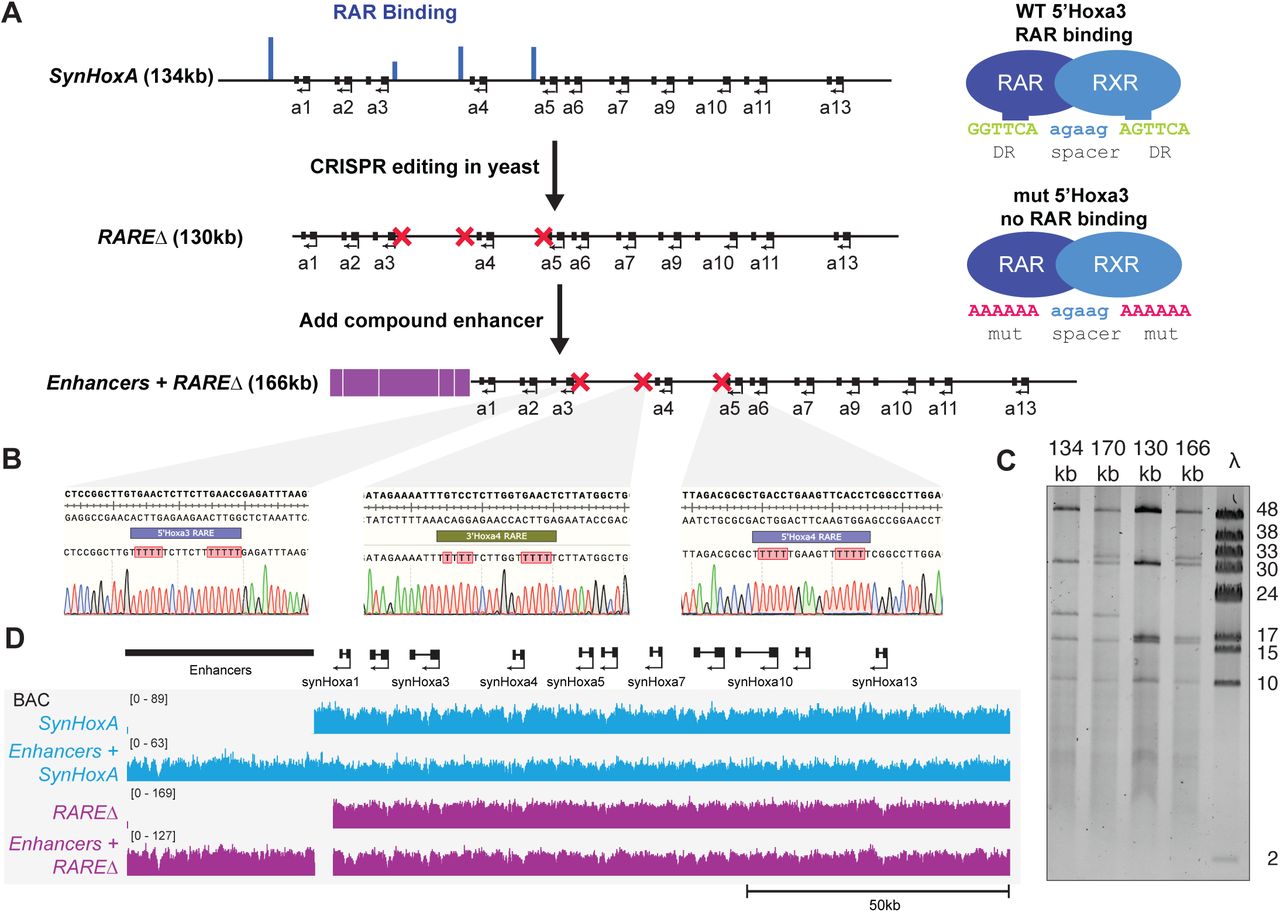
    (A) Schematic of assembly strategy for 130kb RAREΔ SynHoxA and 166kb Enhancers + RAREΔ SynHoxA . Nature of the RARE mutations is shown on the right. RAR binding data comes from previously published reports. (see Methods) (B) Sanger sequencing traces confirmed precise CRISPR editing of RAREs in yeast. (C) SynHoxA assemblon BACs purified from E.coli were digested with PvuI and separated using FIGE. Lambda monocut ladder sizes are indicated in kb. Bands correspond to expected fragment lengths. (D) Sequencing data of assemblon BACs purified from E. coli aligned to a custom mm10 reference genome. Positions of the enhancers and protein coding genes are shown in black.

    Journal: bioRxiv

    Article Title: Synthetic genomic reconstitution reveals principles of mammalian Hox cluster regulation

    doi: 10.1101/2021.07.07.451065

    Figure Lengend Snippet: (A) Schematic of assembly strategy for 130kb RAREΔ SynHoxA and 166kb Enhancers + RAREΔ SynHoxA . Nature of the RARE mutations is shown on the right. RAR binding data comes from previously published reports. (see Methods) (B) Sanger sequencing traces confirmed precise CRISPR editing of RAREs in yeast. (C) SynHoxA assemblon BACs purified from E.coli were digested with PvuI and separated using FIGE. Lambda monocut ladder sizes are indicated in kb. Bands correspond to expected fragment lengths. (D) Sequencing data of assemblon BACs purified from E. coli aligned to a custom mm10 reference genome. Positions of the enhancers and protein coding genes are shown in black.

    Article Snippet: 500 ng of lambda monocut ladder (New England Biolabs N3019S) were used as a molecular weight standard.

    Techniques: Binding Assay, Sequencing, CRISPR, Purification